1- How do we know that things last?
Because some start, others remain and others disappear.
2- Why do things age or deteriorate?
Because of the continuous becoming.
3- How do we know that time is continuously increasing?
Because it is measured in terms of the amount of occurrence of a periodic event or the amount of a fraction occurrence of the same event.
4- Is time travel possible?
No, because the past was real but is no longer anymore, and as for the future, we must go through all the moments sequentially.
5- Is space curved?
No, space has no form, we just measure it in three dimensions. Relativity bases its conclusion using the behavior of light "in space."
Saturday, February 9, 2013

Friday, February 8, 2013
INERTIA LAW AND BECOMING
Inertia is the resistance of a body to change its state of rest or motion without the intervention of any force. But, to know whether a body is moving or is at rest we must use a reference frame.
Becoming is the property of matter and bodies to experience changes (1). Changes may be continuous, sporadic or periodic (2). To realize these changes we only need to look at the body at two different moments or for a specific interval. This interval is expressed by the reference values (duration). To know how much has gone on an event we should use the reference values.
A body can be at rest or in motion depending on the reference frame we use. The motion is relative. Time always goes by from a beginning to an end in one sense, It's irreversible. The "standard" reference value we get it from a continuous and uniform becoming.
Reference frames are applied to the motion (inertia) and the reference values are applied to becoming. Although the movement is part of becoming.
(1) Contrary to the becoming are ideas (concepts and mathematical entities), which are immutable. Ideas aren't held neither to space nor time.
(2) Earth movements are continuous changes, midnight and noon are periodic. An earthquake is sporadic.
(3) The Philochrony is the theoretical framework used to explain the nature of space and time.
Becoming is the property of matter and bodies to experience changes (1). Changes may be continuous, sporadic or periodic (2). To realize these changes we only need to look at the body at two different moments or for a specific interval. This interval is expressed by the reference values (duration). To know how much has gone on an event we should use the reference values.
A body can be at rest or in motion depending on the reference frame we use. The motion is relative. Time always goes by from a beginning to an end in one sense, It's irreversible. The "standard" reference value we get it from a continuous and uniform becoming.
Reference frames are applied to the motion (inertia) and the reference values are applied to becoming. Although the movement is part of becoming.
(1) Contrary to the becoming are ideas (concepts and mathematical entities), which are immutable. Ideas aren't held neither to space nor time.
(2) Earth movements are continuous changes, midnight and noon are periodic. An earthquake is sporadic.
(3) The Philochrony is the theoretical framework used to explain the nature of space and time.
Saturday, February 2, 2013
CLASSES OF REFERENCE POINTS
The reference points are divided into reference frames (space) and reference values (time). Reference frames are subdivided into inertial (if the observer is at rest or moves with constant velocity) and non-inertial (if the observer moves with variable speed or acceleration).
Reference values can be:
- Standard: those we see commonly in clocks.
- Relative: those obtained at high speeds including c.
- Regressive: travels to the past.
- Progressive: travels to the future.
Although I believe that time travels aren't feasible, I've included them because some think so.
Reference values can be:
- Standard: those we see commonly in clocks.
- Relative: those obtained at high speeds including c.
- Regressive: travels to the past.
- Progressive: travels to the future.
Although I believe that time travels aren't feasible, I've included them because some think so.
REFERENCE POINTS (EDITED)
A reference point is the specific place or situation used to orient us in space or in time. Different to the reference points of the space, in time, reference points are constant flowing, changing.
Space (Reference frames or the position of the observer):
- Cardinal Points
- Geographical coordinates
- The corner between two streets
- A house or a building
- A house wall or object in it
- Others
Time (Reference values or the passed interval):
- Movements of the Earth
- Clocks and calendars
- Cycle of life, cycle of pregnancy, a movie, a song, etc..
- Others
Why reference values in time?
Thinking is the act of intelligence which is the ability to handle abstract symbols. We can think of time and intuit it (It exists) but neither represent it nor imagine it. Using a measure of time (value), e.g. 30 sec, we think and intuit that interval.
Space (Reference frames or the position of the observer):
- Cardinal Points
- Geographical coordinates
- The corner between two streets
- A house or a building
- A house wall or object in it
- Others
Time (Reference values or the passed interval):
- Movements of the Earth
- Clocks and calendars
- Cycle of life, cycle of pregnancy, a movie, a song, etc..
- Others
Why reference values in time?
Thinking is the act of intelligence which is the ability to handle abstract symbols. We can think of time and intuit it (It exists) but neither represent it nor imagine it. Using a measure of time (value), e.g. 30 sec, we think and intuit that interval.
Thursday, January 31, 2013
PHILOCHRONY AND THE SPACE-TIME GRAPHIC
The Philochrony is the theory that describes the properties of space and duration, and the relationships between them. Space is characterized for having extension and three dimensions (length, height and width). Duration is characterized for having becoming (continuous succession of changes) and one dimension (time).
Speed is the magnitude that relates space and duration indicating the distance traveled in the time unit.
Do the trajectories exist in the space-time graphics really?
"You're still at 3 feet from me. Your "trajectory" in the space-time graphic is a straight vertical line shown in the figure".

X axis: distance (meters). Y axis: time (seconds).
The trajectories in space-time graphics are not real, they are only observable if the observer is outside of time, and no observer can be outside of time. In the graphic, the time of the observer and the subject pass equal, parallel. This also applies to the curvature of space-time graphic. The curvature of light when passes near the sun is a real phenomenon and different to the curvature of space-time graphic. The light is bent by the sun gravity. This is a spatial curvature, and not of the space-time.
MODIFIED GRAPHIC
"You're still at 3 feet from me (green). Your "trajectory" (red) in the space-time graphic is a straight vertical line shown in the figure".

Speed is the magnitude that relates space and duration indicating the distance traveled in the time unit.
Do the trajectories exist in the space-time graphics really?
"You're still at 3 feet from me. Your "trajectory" in the space-time graphic is a straight vertical line shown in the figure".
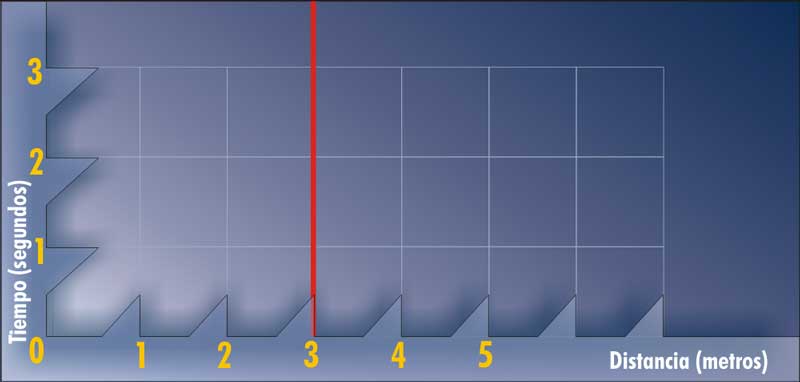
X axis: distance (meters). Y axis: time (seconds).
The trajectories in space-time graphics are not real, they are only observable if the observer is outside of time, and no observer can be outside of time. In the graphic, the time of the observer and the subject pass equal, parallel. This also applies to the curvature of space-time graphic. The curvature of light when passes near the sun is a real phenomenon and different to the curvature of space-time graphic. The light is bent by the sun gravity. This is a spatial curvature, and not of the space-time.
MODIFIED GRAPHIC
"You're still at 3 feet from me (green). Your "trajectory" (red) in the space-time graphic is a straight vertical line shown in the figure".
Friday, January 25, 2013
MIND AND DIMENSIONS
The representation is the ability to evoke images from the senses. Thought is the act of intelligence. Intelligence is the ability to handle abstract symbols. Imagination is the ability to form ideas that aren't originated in the senses.
We can think of a fourth dimension of space, but neither we can represent it (mentally) nor we can imagine it, nor we intuit it because doesn't exist. We can think of time and intuit it (It exists) but neither represent it nor imagine it. Using a measure of time, e.g. 30 sec, we think and intuit that interval.
To represent, to imagine and to think are different.
A projection of the fourth dimension of space. The tesseract in movement.

Time is an epiphenomenon of becoming.
Epiphenomenon: A secondary phenomenon that results from and accompanies another.
We can think of a fourth dimension of space, but neither we can represent it (mentally) nor we can imagine it, nor we intuit it because doesn't exist. We can think of time and intuit it (It exists) but neither represent it nor imagine it. Using a measure of time, e.g. 30 sec, we think and intuit that interval.
To represent, to imagine and to think are different.
A projection of the fourth dimension of space. The tesseract in movement.
Time is an epiphenomenon of becoming.
Epiphenomenon: A secondary phenomenon that results from and accompanies another.
Thursday, January 24, 2013
DIMENSIONS
One dimension is the direction in which are projected the reference points and generate the line or the length (1D), the area or the surface (2D), the volume (3D) and the time (4D). The length is projected towards the right or towards the left of the reference point (R. P.). The height is projected upwards or downwards of R. P. The width is projected forward or backward of R. P. The time is only projected from before to after (We know from experience). Although with no chromnesia we wouldn't perceive time. Without memory an experience would always seem new and we wouldn't distinguish between past and future. Time is the dimension of becoming, even in Mathematics treats time as a dimension of space. The dimensions of space generate forms, the becoming generates new changes and new beings.
Why the use of two concepts: becoming and time?
Because the becoming is real and perceptible and time is a mathematical entity.

Why the use of two concepts: becoming and time?
Because the becoming is real and perceptible and time is a mathematical entity.

Subscribe to:
Posts (Atom)